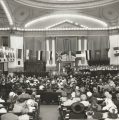
Following is a brief history of FBC Waco. Check out our website at fbcwaco.org to see what’s going on today.
First Baptist Church Waco organized in 1851 when several local residents united under the leadership of Baptist missionary Noah Byars. The new congregation called Byers to remain as their pastor and adopted a church covenant in which they pledged themselves “to the support of the poor of the church, and for the maintenance of a faithful ministry of the gospel among us, and for the spread of the gospel throughout the world.” This mission of compassionate benevolence, gospel proclamation, and global witness has shaped First Baptist Waco throughout its history and continues to guide us today.
First Baptist Waco began its ministry in cooperation with neighboring churches. The Methodist Church shared its building, a log cabin on the corner of 2nd and Jackson, for three years. At that time Byars resigned in order to continue his missionary work among frontier villages. Meanwhile, First Baptist’s second pastor, Solomon O’Bryan, began fundraising for the church to construct its own building.
The resulting brick building on the corner of 4th and Mary enabled First Baptist to expand its ministries greatly. In this new space, First Baptist hosted the newly organized Trinity River High School, an educational project of the Trinity River Baptist Association with which the church affiliated. The Association and the congregation alike understood education, particularly for aspiring ministers, as vital preparation for “the maintenance of a faithful ministry of the gospel.” The high school eventually became Waco Classical School and then Waco University before merging with Baylor University when the latter moved to Waco in 1885. Education has remained important to First Baptist Waco’s gospel mission. Along with counting many Baylor faculty and staff among its membership, the church has also hosted two Baptist seminaries during their first years, shared campus space with Waco Baptist Academy and Live Oak Classical School, and provides reading and tutoring volunteers to a nearby public elementary school. O’Bryan completed his building campaign and remained as pastor for several years. In 1860, W.H. Bayliss was called to pastor the church. O’Bryan remained active in Waco, however, continuing to preach to African-American slaves and launching an ordination program for those called to pastor, black or white.
The Civil War placed tremendous strain on the church. Pastor Rufus Burleson divided time between First Baptist and his other responsibilities as president of Waco University and chaplain to Confederate troops. After the war, 105 newly-freed slaves requested dismissal from First Baptist in order to form their own congregations. The church not only granted this request but also provided them with assistance to establish a new church, which they named New Hope Baptist Church. New Hope’s first pastor, Stephen Cobb, was one of the African-American participants in Byers’s ordination training. At New Hope’s 150th anniversary in 2016, First Baptist’s pastor Matt Snowden participated in thanksgiving services celebrating the ongoing gospel partnership between these sister churches.
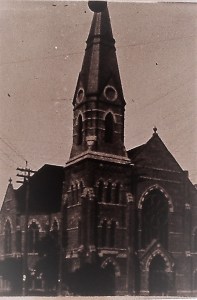
In 1871, First Baptist Waco called B. H. Carroll, one of its longest-tenured and most dynamic pastors, and the Waco and Northwestern Railroad arrived, running directly alongside the church building. The railroad was an economic boon to Waco, transforming it from a rural village into a regional hub, but it also proved a nuisance so close to the church. Not only noise but also smoke and fumes became major disruptions to worship, which would eventually force another move.
First Baptist Waco grew significantly through the combination of Carroll’s pastoral leadership and the downtown growth fueled by the railroad. An 1876 revival lasted almost three months and added 303 members to the congregation. Along with its own growth, First Baptist promoted gospel ministry in the community through founding other churches. The Second Waco Baptist Church organized under the direction of city missionary V. G. Cunningham, hired by First Baptist the same year as Carroll. The First German Baptist Church followed under the leadership of former pastor and Baylor president Rufus Burleson.
During this same period, First Baptist began to make good on its founding pledge “for the spread of the gospel throughout the world.” The church’s truly global witness began with the commission of Dr. W. B. and Anne Luther Bagby and Dr. Z. C. Taylor to Brazil. In 1901, the church commissioned Annie Jenkins to enter missionary training in Chicago in preparation for ministry in China, a notable milestone for both global witness and gospel proclamation by women, another hallmark of First Baptist’s heritage.
By the turn of the century, proximity to the railroad had become unsustainable, and a deacon committee selected a new location owned by Baylor at the corner of 5th and Webster. The site housed a “tabernacle,” a wooden-pavilion used for various meetings including First Baptist services following a fire in 1877. The church purchased the lot from Baylor in 1903, contracted with architect Glen Allen to design the current auditorium, and laid the cornerstone in 1905. First Baptist moved into this neo-Byzantine structure in 1907, constructed at a cost of $74,000 (nearly $2 million today).
The church continued to thrive, especially under Dr. J. M. Dawson, pastor from 1915 until 1946. The church’s global witness multiplied under Dawson, adding missionaries to Uruguay, Nigeria, Argentina, and Chile, with additional missionaries supported by individual members directly. First Baptist’s membership today includes natives of several of these countries, often as international students at Baylor who find at First Baptist a place of belonging and service during their time in Waco.
The church expanded its campus several times during the twentieth-century, adding office and educational space. Expanded ministries of compassion and proclamation drove each of these additions as fresh ministries required more room to grow. The church kitchen hosts not only fellowship meals for members but also cooking for the Gospel Café, a donation-only restaurant for downtown residents, the Agape Meal for neighbors in need, and Meals on Wheels preparation. Educational and recreational spaces host school groups, sewing ministries, children’s sports leagues, a library, and the Low Income Families in Transition (L.I.F.T.) Workshop.
The global witness of First Baptist continues. The church sponsors both short-term trips for members and long-term missionary placements in Mexico, Guatemala, Canada, England, the Czech Republic, Lebanon, Nicaragua, and Shaw, Mississippi. Meanwhile, First Baptist also welcomes people of all backgrounds and ethnicities, hosting a Bible study for international students with members from every continent, a Hispanic partner congregation, the Buffalo River Indian Baptist Church, and the Korean Church of Waco. First Baptist Church Waco extends compassionate service, gospel proclamation, and global witness as expressions of our mission to lead all generations to love God, one another, and the world in the Spirit of Jesus.
 FBCWaco History